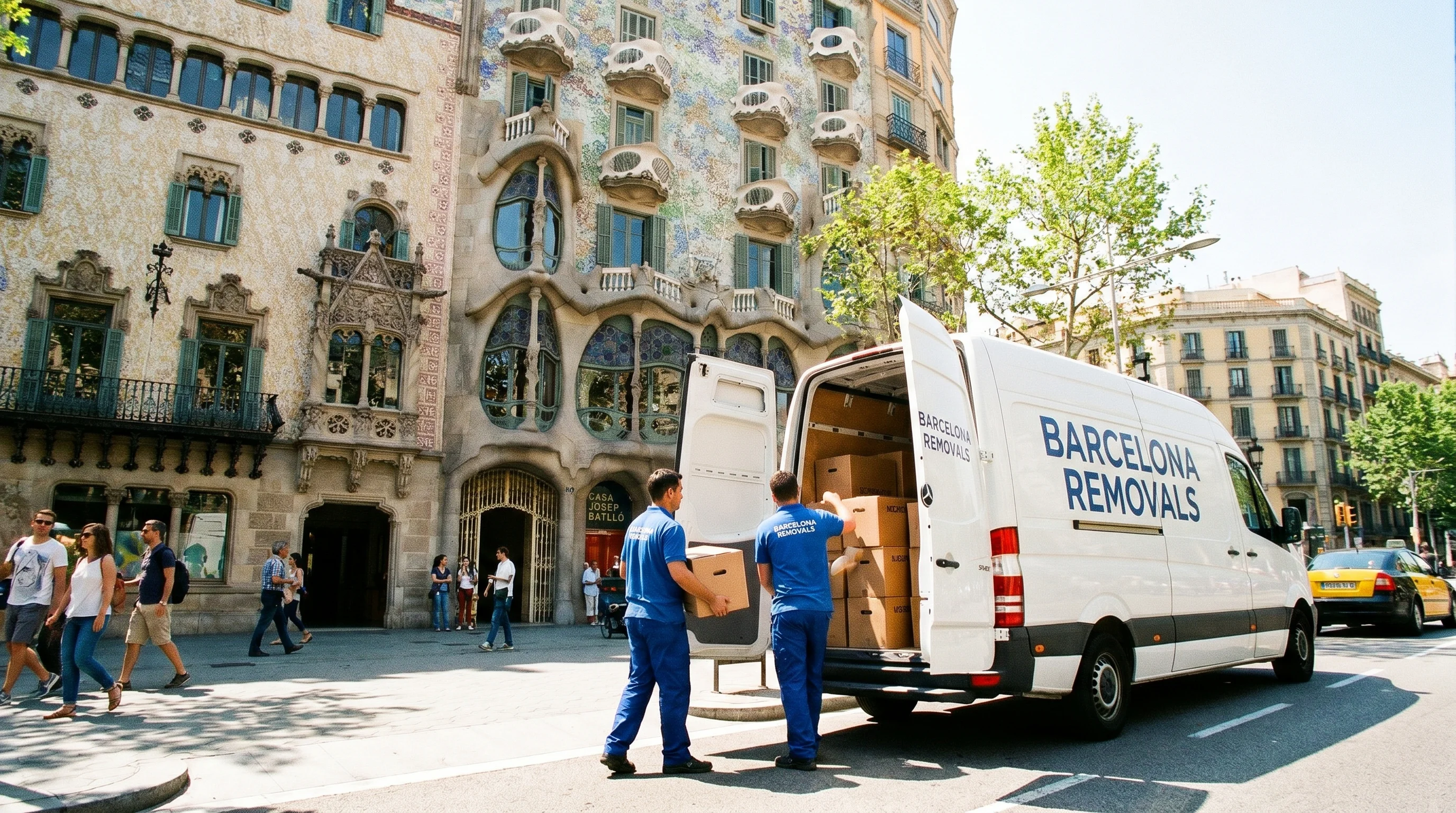
Barcelona's Ciutat Vella — the old city — covers four distinct neighbourhoods: Barri Gòtic (Gothic Quarter), El Born, El Raval, and Barceloneta. Each has its own access rules, street widths, and building characteristics. What works in one won't work in another.
Here's what you actually need to know before booking a man and van in any of these areas.
The Gothic Quarter (Barri Gòtic)
The Gothic Quarter is the most complex area in Barcelona for removals. Streets like Carrer del Bisbe, Carrer del Call, and Carrer dels Banys Nous are too narrow for any van wider than about 1.9m. A standard Sprinter at 2.1m wide cannot enter.
What size van can access the Gothic Quarter?
Only a Long Wheelbase (LWB) van — the smallest commercial vehicle — can physically navigate most Gothic Quarter streets. Even with an LWB, certain alleys require a crew member to walk ahead and guide the driver through gaps of less than 10cm each side.
When is van access permitted?
The Gothic Quarter has restricted access for vehicles. In most pedestrianised streets, van access is only permitted during early-morning delivery windows, typically before 8am. After that, camera-enforced barriers and pedestrian priority make van access impossible in the innermost streets.
We always book Gothic Quarter moves for a 7am start — this gives a clean 60–90 minute window before the barriers are enforced and tourists start filling the lanes.
Building access in the Gothic Quarter
Medieval buildings here were not designed with removal vans in mind. Typical characteristics:
- Stone staircases with low ceilings and tight corners at each landing
- No lift — virtually universal in the Gothic Quarter
- Low doorways (some as low as 1.8m) that large furniture cannot pass upright
- Narrow stairwell width (typically 80–90cm) — sofas must be dismantled or tilted at specific angles
Always check if large furniture can be removed vertically through windows, or whether items need to be dismantled before moving. We assess this on-site before every Gothic Quarter booking.
El Born
El Born is slightly more accessible than the Gothic Quarter. Streets like Carrer del Comerç and Passeig del Born allow short van stops, and some streets are wide enough for an LWB van without a guide.
Practical access in El Born
- Carrer del Comerç: accessible for LWB and sometimes Sprinter vans, morning only
- Passeig del Born: limited stopping possible before 9am
- Interior streets (Carrer de la Argenteria, Carrer dels Flassaders): LWB only, early morning
Building stock in El Born is 18th–19th century. Most buildings have a staircase but no lift. Floor heights are taller than in more modern buildings, which slightly helps with carrying large items around corners.
El Raval
El Raval is the most van-accessible of the four old-town neighbourhoods. La Rambla del Raval is wide and permits van stops. Carrer de l'Hospital, Carrer de Sant Pau, and Carrer de la Cera are manageable with an LWB or small Sprinter.
Buildings in El Raval are a mix of 19th-century tenements (typically 5–6 floors, no lift) and renovated modern apartment conversions (some with small lifts). Always confirm lift availability for El Raval addresses on upper floors.
Barceloneta
Barceloneta is a 18th-century fishing quarter built on a strict grid — but the grid blocks are extremely small and the streets are narrow. What makes Barceloneta uniquely challenging is the combination of:
- Extremely small flats (many are original 1-room plans, 30–45 m²)
- No lift in almost any building
- Very limited stopping positions for vans
- High summer tourist density making any move after 9am logistically difficult in July–August
Passeig Marítim, along the seafront, is accessible for van stopping. For interior Barceloneta streets, we use the LWB van and coordinate with the building about the best stopping point.
The ZER Zone and Old Town
All of Ciutat Vella falls within Barcelona's ZER (Zona d'Emissions Restringides). This means only vans meeting the Euro 4 or higher emissions standard can enter. Our full fleet is ZER-compliant — no access issues on this front.
Practical Checklist for Old Town Moves
- Book a 7am start — not 8am, not 9am. 7am.
- Confirm your building's staircase width and ceiling height on the tightest landing
- Measure any furniture that you're not certain will fit through doorways
- Request an LWB van (not a Sprinter) for Gothic Quarter and inner El Born
- Tell your neighbours in advance — a removal in a narrow street affects everyone on the block
- Check if parking permit is needed for your specific street (ask your landlord)
How Much Does an Old Town Removal Cost?
Old town moves typically cost more than equivalent moves in Eixample or Poblenou for several reasons:
- Early-morning access requirement means the job starts at unsociable hours
- Stair carries on every floor — no lift means time and labour per item
- Smaller van (LWB) holds less, so more trips may be needed for larger volumes
- Access complexity requires a more experienced crew
That said, old town apartments are usually small — many Barceloneta and Gothic Quarter flats are studios or 1-bedroom, which limits total volume. For a furnished 1-bedroom in the Gothic Quarter, budget 3–5 hours including carry time.
We provide fixed quotes for all old town moves — call us with your floor and a rough inventory and we'll give you a number before you commit.